
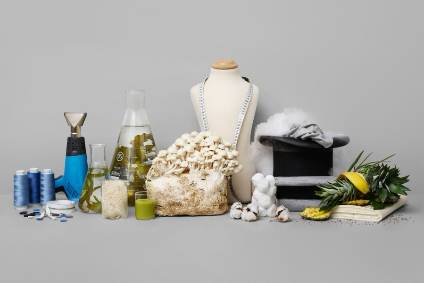
A new technology that converts leftovers from food crop harvests such as flaxseeds, sugar cane and pineapples to make sustainable bio-textiles has won the largest slice of an EUR1m (US$1.24m) grant backed by Swedish fashion giant H&M.
The initiative from the non-profit H&M Foundation, the charitable arm of global fashion retailer H&M, is aimed at spurring ideas to accelerate the shift from a linear to a circular fashion industry.
Other winning projects include The Regenerator (Sweden), Algae Apparel (Israel), Smart Stitch (Belgium) and Fungi Fashion (Netherlands).
“I congratulate all five winning teams,” says Karl-Johan Persson, board member of the H&M Conscious Foundation and CEO of H&M. “They show that innovation knows no national borders and can rest in anyone’s head. This day marks the start of a one-year innovation accelerator where H&M Foundation, Accenture and KTH Royal Institute of Technology in Stockholm will support the winners to cut years off their timeline, bringing them to fashion and innovation hubs such as Stockholm, New York and Shanghai.”
The American team behind the Crop A Porter project will receive the biggest grant of EUR300,000. It is developing a new technology that uses leftovers from food crop harvests such as flaxseeds, sugar cane and pineapples to make sustainable bio-textiles known as Agraloop.
“The Agraloop will kick-off a new paradigm for natural fibre by levering food crop waste for textile fibre production. We seek to help our industry begin to decouple from cotton as the world’s dominant natural fibre resource,” says Isaac Nichelson, spokesperson for Crop A Porter (Agraloop). “Winning the Global Change Award means we can begin to unlock huge value for the textile and fashion industry. We can now propel this important technology much faster into scaled production.”
Nichelson adds the grant will be used for optimising the project’s closed-loop technology, protecting IP, and beginning to produce commercial Agraloop BioFibre fibre productions.
In second place, EUR250,000 is being awarded to a fashion regeneration project based in Sweden which separates cotton and polyester blends.
In joint third place, each securing EUR150,000, are the final three projects.
These include a new technology that turns algae into a bio-fibre and eco-friendly dye that is also good for the skin; a dissolvable thread that makes repairing and recycling a breeze; and Fungi Fashion that makes custom-made clothes from decomposable mushroom roots.


