
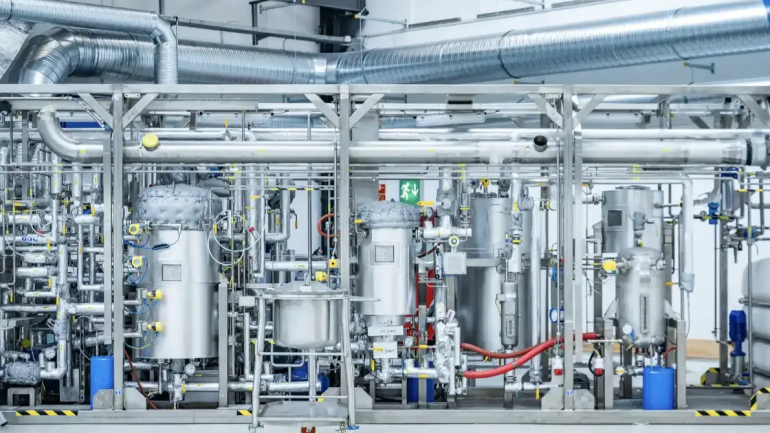
Worn Again Technologies said the Accelerator plant marks the next major step in scaling its proprietary chemical recycling process, which recovers and regenerates polyester and cellulose from end-of-life textiles.
The Textile-to-Fibre Accelerator plant has started up in Winterthur, Switzerland, and showcases the technology at scale, providing real-world validation of the process.
Go deeper with GlobalData


Discover B2B Marketing That Performs
Combine business intelligence and editorial excellence to reach engaged professionals across 36 leading media platforms.
The development comes as the fashion industry faces mounting pressure to address textile waste. Less than 1% of clothes are currently recycled, while textile production exceeds 120m tonnes each year and continues to grow amid strong demand for fast fashion.
“The fashion industry is at a pivotal point,” said Michael Weiss, CEO of Worn Again Technologies. “Blended polycottons, once nearly impossible to recycle efficiently, are now being reimagined through our groundbreaking process. This technology maintains material value, minimises waste, and unlocks significant economic opportunities.”
The Accelerator represents a transition from laboratory innovation to industrial demonstration. In recent years, the company has refined its process chemistry and engineering design, optimising solvent systems and separation techniques to enable efficient recovery of polyester and cellulose fibres.
According to Worn Again, the process recovers more than 95% of solvents used, reinforcing the environmental profile of the technology.
The multi-solvent approach is designed to separate complex materials, including dyes and elastane, which are major challenges for conventional textile recycling methods.
Breakthroughs in textile recycling
Since 2024, the company said it has also achieved breakthroughs by successfully spinning fibres from recovered outputs, improving product purity and quality and supporting the move towards larger-scale operations.
The Accelerator plant is being delivered in modules. The first module is designed to recover spinnable polyester from waste textiles, including post-consumer polycotton blends sourced from Switzerland, the European Union and the United Kingdom.
The recovered circular polyester will soon be available for downstream piloting and product application testing.
A second module, which has entered detailed engineering, will produce next-generation cellulosic fibres and other advanced cellulosic materials.
The Accelerator is also expected to serve as a testing platform for industry partners, allowing companies to evaluate feedstocks and validate the recycling process across different textile streams.
Toby Moss, chief commercial officer at Worn Again Technologies, added: “Testing at this scale will expand our solutions to a broader range of feedstocks, ensuring that we stay ahead by valorising more material streams and creating a growing portfolio of high-value, downstream product applications.”
The company said a network of strategic partners will receive priority access to the Accelerator plant and its circular products.
There are plans in place to expand these partnerships and secure supply and offtake commitments for its first commercial-scale production facility.
With the Accelerator now operational, the company said it is ready to work with brands, manufacturers and waste handlers to scale circular solutions for the fashion industry.


