
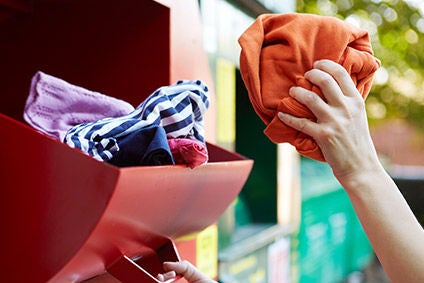
- WRAP says textiles take-back schemes, where customers donate unwanted clothing to retailers to be re-used or recycled, are a key part of developing a more circular fashion industry.
Environmental charity WRAP has published new best-practice guidance to help retailers, brands, and their re-use and recycling partners set up new schemes from scratch, or to improve existing take-back schemes to increase clothing recycling in the UK.
Many consumers are unaware of take-back schemes, with current data showing that only 2% of people choose this route to donate their unwanted clothing compared to more established methods, WRAP says.
Go deeper with GlobalData

Discover B2B Marketing That Performs
Combine business intelligence and editorial excellence to reach engaged professionals across 36 leading media platforms.
It adds post-lockdown, charity shops are likely to see an influx of donations as many people have been storing their items at home until restrictions are lifted. As such, it says the new guide offers retailers a platform to encourage customers to recycle their unwanted items in-store, and as part of online transactions, and enhance this underused collection route.
The guide sets out to help businesses decide which scheme is right for them, by providing a summary of the different schemes available, real-life case studies, information and advice on communications, detailed operational considerations, and helpful tools and resources to ensure success.
WRAP says textiles take-back schemes, where customers donate unwanted clothing to retailers to be re-used or recycled, are a key part of developing a more circular fashion industry. It adds such programmes provide an opportunity for clothing brands and retailers to engage with their customers on sustainable practices, can increase brand loyalty, demonstrate corporate responsibility, and help transition a business towards circularity in clothing and textiles.
Dr David Moon, head of business collaboration at WRAP, said: “This guide will help businesses implement successful take-back schemes that allow their customers to easily donate unwanted clothing. Last summer, post-lockdown, over half of the people we surveyed had a clear out of clothing. We know that citizens would much rather recycle, donate, or re-sell their unwanted items, so take back schemes are going to be imperative to people being able to donate promptly once the shops re-open”.
The ‘Clothing Take Back Guide’ was produced as part of the Sustainable Clothing Action Plan (SCAP 2020), which completed in December 2020. WRAP is currently preparing for the launch of a new ten-year voluntary agreement that will succeed SCAP 2020 and put circularity at the heart of how clothes are manufactured, sold and re-used at end of life – called Textiles 2030.
Textiles 2030 is WRAP’s expert-led initiative that harnesses the knowledge and expertise of UK leaders in sustainability to accelerate the widescale move towards circularity, and system change in the UK’s fashion and textiles industry. It aims to reduce carbon emissions by 40-50%, in line with the Paris Agreement goal of restricting temperature rise to less than 1.5 degrees Celsius.
Click here to access the guide.


