
Hyosung TNC’s Global Sustainability Director–Textiles, Simon Whitmarsh-Knight, details how a $1bn sugarcane-to-bio-BDO investment in Vietnam, in partnership with Geno, is taking regen™ BIO elastane from pilot to scale. With co-located production, VIVE-backed third-party certifications, Hyosung TNC is targeting a 2026 production start and 2027 retail debut—aiming for up to a 55% lower carbon footprint while meeting performance demands across activewear, intimates and denim.
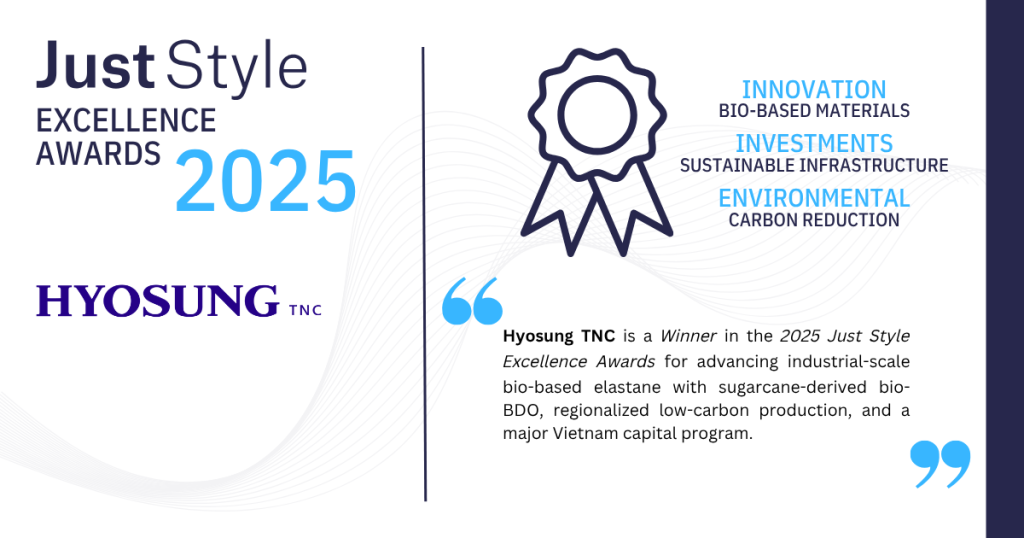
Hyosung TNC recently won three awards in the 2025 Just Style Excellence Awards.
Go deeper with GlobalData


Discover B2B Marketing That Performs
Combine business intelligence and editorial excellence to reach engaged professionals across 36 leading media platforms.
Just Style (JS): Congratulations on winning in the 2025 Just Style Excellence Awards. How do these three awards align with Hyosung TNC’s long-term vision for elastane and adjacent sectors?

Simon Whitmarsh-Knight: Thank you! We are very proud that our regen™ BIO Elastane was recognized as a triple-category award winner in the 2025 Just Style Excellence Awards! These prestigious awards validate our corporate goal for investing in, and developing this innovative fiber. Together with other investments in pioneering textile technologies, we are supporting the industry’s move to more circular business models and our corporate goal to be carbon neutral by 2050.
JS: What early strategic choices proved critical to moving bio-based elastane from concept toward scale?
Simon Whitmarsh-Knight: Hyosung TNC prides itself on being a total sustainable textile solution provider. We introduced RCS-certified 100% recycled elastane into the marketplace in 2020. Beyond recycled elastane, we saw an opportunity to develop a bio-based option for brands and retailers looking for a plant-based elastane to blend with its natural fibers such as cotton, wool, silk and cellulosic materials, in addition to other synthetic fibers. In 2022, we introduced SGS EEPS and USDA-certified regen™ Bio Elastane made with 30% renewable content from corn, and in 2023, we introduced an expanded regen™ BIO-Based elastane offering to include various options for the yarn to be made with a higher content of renewable resources.
In 2024, our $1 billion investment in a bio-BDO facility in Vietnam marked a turning point in sustainable stretch innovation. By pioneering the use of sugarcane-derived bio-BDO, one of the ingredients in elastane, we’ve brought bio-based stretch fibers out of the lab and into full-scale production. This breakthrough tackles elastane’s highest carbon emission stage by substituting fossil-fuel based raw materials with a renewable-based alternative.
In partnership with Geno, whose biotechnology ferments sugars from sugarcane to allow us to create the bio-BDO, we’re providing a drop-in solution that fits seamlessly into existing elastane manufacturing—proving sustainability can scale. Looking ahead, Hyosung TNC is also pursuing a roadmap to recycle in-house waste generated during regen™ Bio Spandex production to create Recycled Spandex, thereby establishing a fully circular system that connects bio-based production to recycling.
JS: Why did you choose sugarcane-derived bio-BDO and partner with Geno?
Simon Whitmarsh-Knight: Selecting sugarcane as the feedstock reduces processing steps compared with alternatives like corn, which require conversion from starch to glucose before fermentation. Fewer steps generally mean less energy use and lower associated emissions.
Following significant market research, we partnered with Geno due to their expertise in biotechnology, accelerating the world’s transformation to sustainable materials by replacing fossil fuel resources with plant-based alternatives. For more than two decades, Geno has been scaling technology to enable the production of sustainable materials derived from plant- or waste-based feedstocks instead of fossil fuel-based materials.
JS: How does co-locating bio-BDO and elastane production in Vietnam change your operating model from R&D through delivery?
Simon Whitmarsh-Knight: Through this vertical integration from raw material to yarn for regen™ BIO Elastane, our goal is to increase production efficiency, provide faster response to our customer needs, and integrate value chains to help minimize carbon footprint. Global sourcing patterns are constantly evolving, and as the only elastane manufacturer in Vietnam, we are well placed to serve our customers looking for alternative value chains.
JS: What are the key milestones to commercial rollout through 2027, and how are you de-risking each phase?
Simon Whitmarsh-Knight: The investment is structured around clear milestones: plant upgrades in Q3–Q4 2025, bio-BDO production beginning in Q1 2026, biobased elastane production in Q2 2026, and apparel using this elastane expected in stores from 2027. This timeline signals execution discipline and allows supply chain partners—mills, vendors, and brands—to plan fiber development, testing, and commercialization in step with material availability.
JS: How are you validating performance parity for demanding categories like activewear, intimates, and denim?
Simon Whitmarsh-Knight: As always before launching products at scale, we conducted rigorous testing with our global mill partners, covering circular knit, warp knit, seamless and wovens. This was followed by extensive wearer trials and garment testing. In addition, we’ve pursued third-party certifications and traceability for bio-based content, referencing programs such as USDA Bio-Preferred, SGS EEPS, and ASTM D6866 testing. This transparency enables brand partners to communicate inputs with confidence through to consumer-facing claims.
JS: Beyond certifications, what proof do brand partners most often request, and how do you provide it?
Simon Whitmarsh-Knight: Many want to know about the traceability of the feedstock. As a result, we’ve joined the VIVE Sustainable Supply Program, to ensure a high level of traceability and transparency from sugarcane farms to fiber production. The VIVE Programme is a globally recognized continuous improvement sustainability program for commodity supply chains, covering all operations and activities for producers through to end users that have a bearing on sustainability. VIVE is a verification platform that has been benchmarked to various certification programs, global standards and industrial buyer criteria.
JS: How will the Life Cycle Assessment inform decisions on energy, water, and logistics once the plant is operational?
Simon Whitmarsh-Knight: Hyosung TNC has established a vertically integrated production system in Vietnam, enhancing efficiency and minimizing transportation distances to reduce environmental impacts such as carbon emissions, energy consumption, and water use.
The company ensures the sustainability of its products and raw materials through certification and verification systems, and continues to make ongoing improvements.
Through these initiatives, Hyosung TNC expects up to a 55% reduction (internal estimate) in carbon emissions compared to regular elastane, along with improvements across other environmental impact areas including water use. A full third-party LCA will be conducted once the plant is operational.

JS: How are you engaging mills and brands to align development and testing timelines with your production ramp-up?
Simon Whitmarsh-Knight: We are working closely with our global brand and retail partners to support their transition to the new product derived from sugarcane. We have shared the key milestones and selected customers have also visited the upgraded facility in Vietnam. Together, we’re collaborating to ensure (i) an effective transition and (ii) clear communication of the benefits to their end-consumers.
JS: What commercial models or incentives are helping customers transition from fossil-based to bio-based elastane?
Simon Whitmarsh-Knight: Regulations are one of the key short-time drivers of behavior change. The biggest incentive is the European Green Deal (EUGD) regulation to reduce net greenhouse gas emissions by at least 55% compared to 1990 levels. Supported by this incoming legislation, brands and retailers are looking for ways to reduce their carbon footprints through responsible materials, such as recycled fabrics or materials made with bio-derived resources.
JS: Where is near-term demand for bio-BDO strongest beyond apparel, and how are you structuring cross-sector collaborations?
Simon Whitmarsh-Knight: Ultimately, the investment extends beyond apparel, as bio-BDO can also serve the footwear, packaging, and automotive markets. This broader impact helps advance renewable materials across industries and highlights the company’s role in building sustainable infrastructure, not just expanding production. We’re working across the Hyosung group to provide efficient supplies across all of our customers.
JS: If you could align the industry around one shared priority for the next three years, what would it be and why?
Simon Whitmarsh-Knight: Collaboration. The systemic problems we face as an industry are too complex for any one company to solve on their own. The only way we can make significant impact is through collaborating at all levels across the value system to unlock real progress.
JS: Simon, thank you for the clear roadmap. Your move to vertically integrate sugarcane-derived bio-BDO and elastane in Vietnam, paired with transparent verification and cross-sector applications, offers a pragmatic template for scaling low-carbon stretch. We look forward to tracking the 2026 ramp and how your closed-loop ambitions around recycled spandex advance true circularity.
About Simon Whitmarsh-Knight
Simon has extensive international experience growing new business in sustainable fibers, technical textiles and performance apparel. Having worked for global brands, retailers and manufacturers, Simon’s background includes building brands and aligning teams across cultures in dynamic markets, and supporting supply chain transformation through the textiles value system. Simon currently leads sustainability for Hyosung, the world’s largest elastane manufacturer by market share, who recently announced a $1bn investment in upgrading their Vietnam facility to produce bio-based elastane derived from sugarcane.



