
Prior to CreateMe, Cam was on the founding executive team for Group Commerce (acquired by Blackhawk Network), and previously held roles at DoubleClick and Allen & Company. Cam holds a BA with Honours and a Masters of Art in History from the University of Cambridge, and received his MBA at Northwestern University.
1. Congratulations on the dual awards. Beyond these awards, what long-term problem in apparel manufacturing is CreateMe fundamentally trying to solve?
Go deeper with GlobalData


Discover B2B Marketing That Performs
Combine business intelligence and editorial excellence to reach engaged professionals across 36 leading media platforms.
Modern apparel manufacturing still runs on nineteenth-century logic: manual dexterity scaled through human labor. That model pushed production offshore, separating manufacturing from demand and locking in long lead times, overproduction, and structural economic and environmental waste. As tariffs, transportation costs, and labor constraints rise, the system is becoming increasingly brittle.
CreateMe addresses this at the system level by redefining how garments are made. By combining advanced robotics, proprietary adhesive bonding, and Physical AI, we enable automated production closer to the consumer with speed and consistency sewing cannot achieve. The result is demand-aligned manufacturing that reduces excess inventory, cuts waste, and creates a more responsive and efficient apparel supply chain.
2. What early strategic bet did you make that competitors underestimated, and how has it paid off?
Most attempts to automate apparel try to replicate sewing with robots, despite sewing requiring two-sided access and continuous manipulation of deformable fabric. We took a first-principles view and rebuilt the process around adhesive-based assembly.
Adhesive bonding enables single-sided access and a static, fixture-controlled joining environment. By treating garments as 2D and 3D forms to be shaped and bonded rather than pierced and stitched, we created an architecture software can perceive reliably and robots can execute repeatably. That decision unlocked digital workflows with higher precision, faster cycle times, and scalable automation across categories—an approach many competitors underestimated by focusing on automating sewing rather than rethinking assembly.
3. How do you prioritize which categories to automate next, and what gates must be cleared?
We prioritize high-volume staple categories where automation enables a fundamentally different production model. Sewing pushed these items offshore, requiring long lead times and large minimums to make the economics work. We start with T-shirts and intimates, then expand to closely related constructions such as polos, men’s underwear, and simpler bras, where bonded assembly principles and tooling architectures can be reused.
Each category must clear consistent gates: sufficient baseline volume, manageable material variability, compatible 3D geometry, and tolerance requirements within an automatable range. Commercially, the benefits are strongest in categories where automation unlocks onshore manufacturing flexibility—low minimums, wide size grading, and rapid turnaround—that offshore models struggle to deliver. Beyond apparel, we expand selectively into adjacent categories where both technical fit and customer pull are clear.
4. What “last‑mile” challenges did you overcome moving from prototypes to commercial bonded intimates?
The challenge was moving from proof-of-concept bonding to production-grade fine-dexterity control, particularly precise visual and aesthetic alignment at seams and edges. Commercial production required repeatable control of stretch, registration, and edge placement at throughput.
The breakthrough was robotic tooling that actively stretches, tensions, and locally constrains fabric in a static, fixture-controlled assembly state, mirroring how a skilled operator prepares a seam. This absorbs material and cut-part variation while maintaining tight tolerances and clean, repeatable visual alignment at scale.
5. Where did your assumptions about deformable material handling prove wrong, and how did that reshape your roadmap?
We initially assumed tight process control could make fabric behave consistently, similar to rigid parts. That assumption proved wrong. Fabric varies piece to piece and lot to lot, and small differences compound quickly in automated assembly.
This pushed us from fixed rules to learning-based manipulation. We developed techniques to stretch, position, and locally stabilize fabric, then allowed the system to adapt through repetition. Once learning was in place, skills began to transfer across products—T-shirt placement informed intimates; sleeve handling improved waistband control—shifting our roadmap from isolated workflows to a software-defined platform that reuses and compounds assembly intelligence.
6. Which customer pain points are you solving first, and how are you sequencing solutions?
We start with the most costly pain point for brands: long lead times and offshore dependency, which force speculative production, excess inventory, and markdowns. Our onshore, automated bonded production compresses cycles from months to days, improves sell-through, and reduces reliance on scarce sewing labor.
From there, we sequence flexibility where it matters most: lower minimums, wide size grading, and rapid iteration. The goal is production that stays aligned to real demand rather than long-range forecasts.
7. How are pilots and commercial agreements structured to share risk and prove value quickly?
Early engagements are structured as tightly scoped test lanes around a single product or capsule. Pilots validate consumer-grade quality and aesthetics alongside core manufacturing KPIs such as yield, throughput, and repeatability, within a short, production-representative window. A shared set of production parameters is agreed upfront between CreateMe, the brand, and the manufacturing partner, ensuring aligned expectations and balanced commitment.
Because MeRA™ and Pixel™ are modular and software-defined, results map directly to production requirements. Manufacturers use pilots to confirm operational readiness before licensing systems, while brands validate quality, economics, and demand response before committing to scale. This structure manages upfront risk while accelerating and aligning evidence-based commercialization decisions.
8. What unit‑economics threshold made onshore bonded production competitive, and how did you cross it?
We crossed the threshold by reframing competitiveness from offshore FOB pricing to a landed, duty-paid cost at the distribution center. That benchmark reflects the economics brands actually incur, including shipping, duties, lead-time risk, working capital tied up in transit, and the cost of overproduction—pressures amplified by recent tariff changes.
Viewed this way, onshore bonded production competes by eliminating shipping and duty burdens, compressing time and inventory risk, and delivering higher revenue per square foot. A continuous roll-to-roll MeRA™ cell integrates cutting, handling, and bonding in a compact footprint while removing dependence on scarce, specialized sewing labor. By shifting the labor model toward generalized assembly supported by automation and combining that with demand-driven production and improved sell-through, onshore bonded manufacturing becomes structurally competitive on a true landed-cost basis.
9. How do you plan capacity—cell size, throughput, and redundancy—when demand and styles shift frequently?
Capacity planning is built around modularity, continuous flow, and software-defined flexibility. Core assembly runs in standardized 2D bonding modules, while silhouette-specific steps sit in swappable workstations, allowing lines to pivot across styles without resizing the cell.
Cell size is fixed and repeatable. Throughput scales by adding parallel modules rather than stretching cycle time or labor. Roll-to-roll, single-piece flow lets output track demand linearly, while parallel robotic stations provide physical redundancy. Because MeRA™ derives motion directly from CAD, size grading and silhouette changes are handled through software, maintaining high utilization as demand shifts.
10. What quality or comfort metric best shows bonded garments outperform traditional sewn options in real wear?
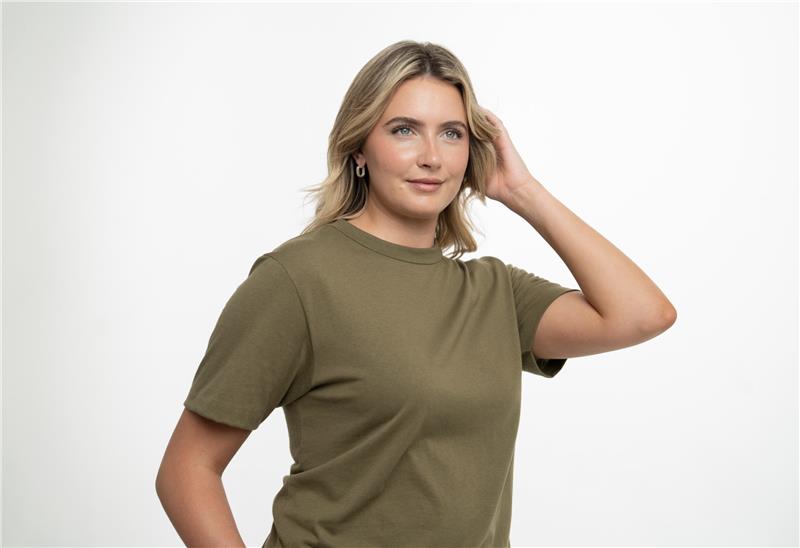
The most telling metric is seam comfort under real wear, without sacrificing durability. Pixel™ micro-adhesive seams consistently match or exceed sewn tensile and wash durability while eliminating the bulk, stiffness, and chafing inherent to stitched or taped seams. Sub-millimeter bonding preserves fabric stretch and drape, resulting in a lighter feel and more consistent fit over time. These benefits have been validated not only in intimates, but also in everyday garments such as T-shirts, where comfort and durability are immediately noticeable.
11. How do you maintain sub‑millimeter precision at scale across diverse fabrics and finishes?
We maintain sub-millimeter precision by creating a controlled, static assembly environment and closing the loop between perception and motion in real time. Purpose-built tooling stretches, tensions, and locally constrains fabric to establish repeatable reference geometry, while heat-and-vacuum grippers secure the material and activate the adhesive during bonding.
High-resolution vision systems register alignment across assembly and verification, driving automatic micro-corrections in robotic motion. Physical AI provides the adaptive layer, learning material behavior and recalibrating process parameters to counter differences in stretch, surface finish, and fabric physics. This allows precision to be maintained across fabrics, lots, shifts, and volume.
12. How are adhesive formulations, design rules, and end-of-life pathways aligned to make circularity operational?
For CreateMe, circularity begins with shifting from sewn construction to an adhesive-based assembly architecture. Seams are designed from the outset for automation, precise adhesive deposition, and controlled assembly, removing many of the barriers that make disassembly impractical in traditional garments.
Within that architecture, we developed Thermo(re)set™ as a reversible adhesive formulation for circular applications. Pixel™ digitally applies and controls that formulation, translating design intent into repeatable seam construction. By aligning adhesive chemistry, seam design rules, and process control, circular end-of-life pathways can become operational rather than aspirational.
13. What infrastructure or partnerships are needed for automated disassembly and materials recovery at scale?
Scaling automated disassembly and materials recovery is less about inventing a single new piece of technology infrastructure and more about coordinated adoption across the ecosystem. We’ve validated the core disassembly process itself, but scaling it requires bringing that capability into real-world environments where post-consumer variability can be addressed in pilots.
A key enabler is that adhesive-bonded construction allows disassembly and recovery to be designed directly into the manufacturing process, rather than relying on complex downstream intervention. This lowers the barrier to adoption and creates a clearer economic incentive for brands, recyclers, and technology partners to collaborate. Progress then depends on aligning the right partners—brands, chemical formulation providers, robotics and sorting companies, and recycling partners—and piloting together under real operating conditions. Once viable workflows and economics are established, the necessary infrastructure can follow.
14. What unique datasets from MeRA drive continuous learning, and how will Gen 2 robotics change flexibility?
MeRA™ functions as both a manufacturing system and a data engine, generating high-resolution vision data on fabric deformation, bonding behavior, and quality outcomes across every assembly step. Collected over hundreds of prototypes and thousands of process tests, this creates one of the industry’s first structured datasets linking material behavior, process parameters, and end-product quality for deformable materials.
As we move toward Gen 2 robotics, this dataset becomes the source of flexibility. Instead of hard-coding workflows, robots learn how materials respond to specific tools, forces, and sequences, allowing cells to swap tools, adjust digital assembly recipes, and move across categories by reusing and fine-tuning existing skills. As the dataset compounds, new product onboarding becomes faster and less hardware-dependent, enabling a factory that improves with use rather than resetting with each program.
15. How does a distributed, nearshore cell model change inventory decisions and markdown risk for brands?
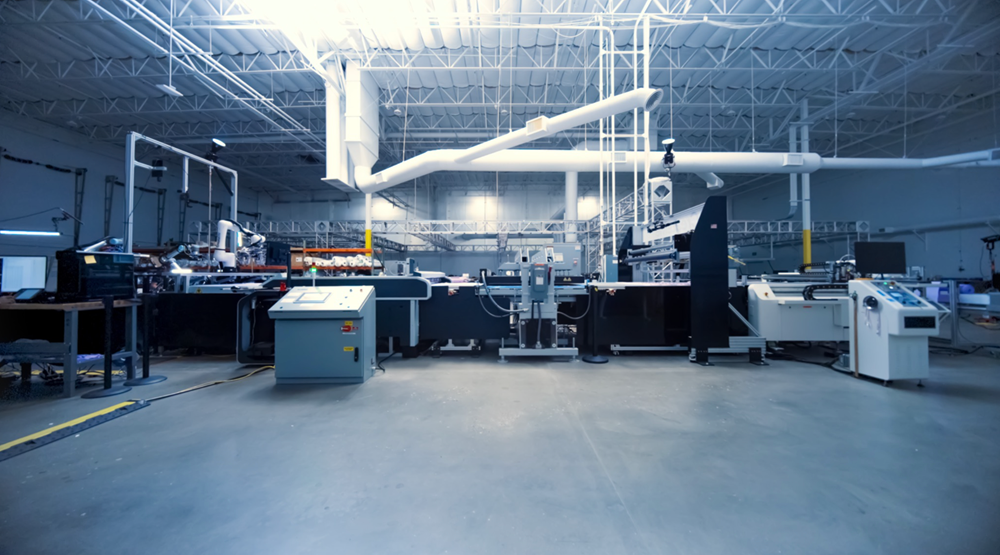
A MeRA™ cell is a compact, modular microfactory designed to operate close to the end consumer while remaining cost-competitive with offshore sewing. A single line occupies roughly 1,200 square feet, produces about 250 units per hour, and delivers high output density per square foot. At scale, mass-production lines reach roughly one million units per year, making it practical to distribute capacity near demand centers rather than concentrate it offshore.
For brands, this proximity changes inventory decisions. Instead of committing to large seasonal buys months in advance, brands can place smaller initial orders, respond to real sell-through, and replenish in days rather than months. Inventory shifts from forecast-driven to demand-driven, reducing overproduction, excess stock, and markdown exposure. Over time, the same model extends to other high-wage, consumer-adjacent markets globally.
16. How do you turn your IP portfolio into a practical moat, and where are you open to collaboration?
Our IP protects a system-level architecture built through years of focused R&D, with over 95 patents spanning adhesives, robotics, and software for fabric perception, soft-material handling, and process control. This includes Pixel™, Thermo(re)set™, and our MeRA™ robotic assembly systems.
What differentiates CreateMe is how these elements are unified through Physical AI into a single platform where materials, tooling, and robotic behavior are coordinated through software and improve through sustained use. We protect that core while collaborating through structured licensing—deploying complete or modular systems in apparel, and scoping defined applications in adjacent categories where the same assembly principles apply.
17. What milestones will signal readiness as you expand into tees, athleisure, and new geographies over the next 24 months?
Readiness is defined by moving pilot systems into sustained commercial production and scaling into repeatable mass-production platforms. Through 2026, we are running intimates and T-shirts in pilot cells to generate runtime data, improve yield, and guide system upgrades.
In parallel, we are merging our mechanical and robotic automation roadmap with our Physical AI roadmap to eliminate human-driven fine-dexterity setup. By 2027, we are targeting mass-production launches for intimates and T-shirts. Expansion into additional categories and geographies will follow primarily through customer pull, once those platforms are fully industrialized and repeatable.


