
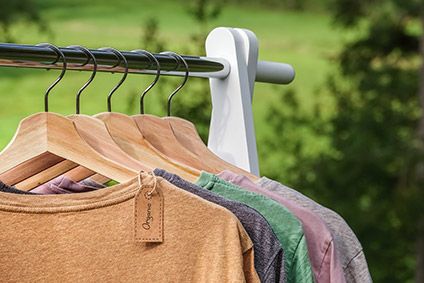
Sustainability is growing in importance to fashion shoppers, but they are becoming increasingly aware of when a company is greenwashing and are becoming less inclined to take claims at face value.
Speaking on a recent webinar on ‘What makes a sustainable fashion brand?’ organised by product development and production management platform SupplyCompass, Tom Berry, global director of sustainable business at luxury brands marketplace Farfetch, said consumers are starting to look for products that feature certifications to prove their credibility.
Delving deeper, Berry said consumers are starting to understand that they should not be taking a claim at face value and are looking for products to feature certifications to prove their credibility.
Generally, he added, consumers don’t have the time when they are shopping to look into what certifications the brand has, whether organic or Fairtrade. Instead, they want to be able to see it in front of them in order to make an informed decision. “Retailers can help here, so can brands, in guiding consumers so long as they are transparent and make clear what their standards are.”
He said the growing number of accrediting bodies can also make it confusing for a customer to select a product.
“When I was working in the food industry a while back, I got a question about how you might choose between beans grown in Kenya that are Fairtrade, and beans grown locally, both of which are ‘good things.’ I said as long as you’ve taken the time to look into it and narrow it down to those two, you should choose the one that best fits your need. Just don’t buy the beans where you have no idea where they came from or how they were grown. That’s the key thing. It’s a good rule of thumb. Buy something you can feel good about and don’t beat yourself up if it doesn’t meet every standard under the sun.”
• Conscious consumerism and new business opportunities in alternative models are fuelling the rise of sustainability.
• Both retail and technology can help guide consumers into making easier, better decisions – the latter also helping in collating and analysing data through hundreds of data points.
• Spotting greenwashing through research and diving into the details required honest, factual communication from brands.
• Growth without an increase in material consumption, and breaking down internal barriers by making sustainability meaningful to each area of the business, is vital.
Communication
How can businesses better communicate sustainability with consumers?
“Simply start by communicating somewhere where consumers do care,” said Sandra Capponi, co-founder of Good On You, an app that helps consumers choose fashion brands that have a positive impact on people, the planet and animals.
“There are a growing number of people that do care. Good on You’s approach is not to expect brands to include sustainability issues as part of their marketing or positioning, but just that they have covered it somewhere on their website or as part of their shareholder reporting. Just talk somewhere what you are doing about protecting people in your supply chain, how you are thinking about trying to reduce the environmental impact of your processes.
She warned “sweeping statements” were increasingly being questioned by consumers.
“Some brands have gone from saying nothing at all to making really big claims – 100% carbon offset, that sort of thing – and I think that is maybe leading to consumer scepticism around what brands are really saying. That’s a typical sign of greenwashing. People are looking for brands to take responsibility all the way down the chain from production right to what happens to the product after they’ve sold it. Communicating that in a way that is impactful and meaningful is what I think consumers are looking for and what Good on You picks up in our assessment and brand ratings.”
Growth focus
Webinar host Flora Davidson, co-founder of SupplyCompass, noted that sustainability and the growing focus on “slow fashion” can be a complicated topic as the fundamental goal of every business is to capture growth.
Berry responded that sustainability questions always come down to whether “capitalism really works.”
“As a brand, you are always going to want to grow. Saying you want to grow slowly – what does that even mean? But saying you want to grow in better ways, for example decoupling growth wth resource consumption, so where you are basing your growth on low impact, zero impact or even regenerative sources – using dead stock to make smaller quantities of things – that is a better way of growth than the other way, using brand new materials at massive quantities.
“It’s about looking at growth opportunities that aren’t based on new materials and trying to be as efficient as possible. Trying to tackle how much growth or consumption is enough is hard for any business to answer.”
But Capponi said production and consumption must reduce in order to address “some of the core problems around the world.”
“Buying less can mean other things; exploring alternative, buying second-hand, renting, mending and repairing. All of these are services that brands and retailers can provide.
“And making more considered quality choices. For example buying more clothes that are cheaper, over time could be replaced with fewer purchases at a higher initial cost but a similar cost per wear. That has the same economic impact for customers but fewer social and environmental impacts. That way we end up with clothing we can cherish over time rather than this throwaway culture we have gotten used to.”
Davidson quizzed whether that could that mean the end of the fast fashion genre.
“There will always be a need for affordable clothing,” Capponi responded. “People are in different situations. Hopefully we can support an industry that supports different options at different prices for those that can afford it at the time. But the model that underpins fast fashion – high turnover, constant production of really cheap disposable clothing – that has to change. But it will be driven by consumer demand that doesn’t stand for that anymore.”
On whether production should be regulated and if it is necessary to introduce a “fast fashion tax,” she said: “I think there is always a role for government regulation but it is so dependent on a particular location. As we know, fashion is global. A more proactive, stronger response will come from brands themselves and from those of us that love and buy fashion.”



