
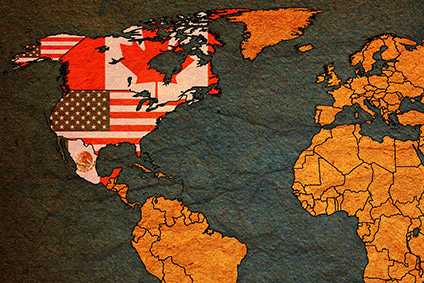
A cohort of apparel industry associations have joined forces to urge NAFTA trade ministers to negotiate rules of origin that preserve existing flexibilities, avoid new restrictions, and include new provisions that expand trade.
North American Free Trade Agreement (NAFTA) talks between the US, Canada and Mexico enter their sixth round in Montreal tomorrow (23 January). However, President Donald Trump has signalled he could suddenly cancel the deal – something Canadian officials have said is increasingly likely as Mexicans continue to skirt his “America First” agenda.
In an open letter dated 19 January to Ambassador Lighthizer, Minister Freeland, and Minister Guajardo, eight trade associations including the American Apparel & Footwear Association (AAFA), the Canadian Apparel Federation, and the National Retail Federation (NRF) call for an outcome that supports North American textile, apparel, and retail jobs.
“NAFTA supports a vibrant North American cotton, textiles, and apparel supply chain, and all the associations signing the letter support continuing NAFTA and oppose withdrawing from NAFTA or rendering it unworkable or uncompetitive,” wrote the signatories, which also include the US Fashion Industry Association.
It continued that, “vitally important” to that objective is a NAFTA that features “state of the art textile and apparel rules of origin (ROO)” that retain existing flexibilities, include new provisions that can expand trade, and avoid new measures that restrict trade.
On the former point, the associations say: “The NAFTA ROO is built upon a yarn-forward rule, which has enabled the development of an integrated supply chain between the United States, Mexico, and Canada. Critical to the smooth functioning of that ROO are flexibilities that enable companies, in all parts of that supply chain, to use non-originating materials when those needs arise. Incredibly, even though trade has changed they are as important now as they were 25 years ago. Eliminating them would unravel supply chains, injuring the jobs they support.”
On the new provisions, the associations agree that NAFTA can be updated to expand flexibilities and incorporate concepts that were not known 25 years ago.
“For example, any discussion of tariff preference levels (TPLs) should in fact look at increasing those levels to reflect higher trade flows than what existed in the early 1990’s, when the original levels were set. Incorporating other flexibilities that have worked in other agreements, such as a workable short supply process or cumulation, should also be on the table.”
At the same time, they say NAFTA 2.0 should avoid any measure that would further limit trade through, for example, new restrictions in the ROO, including the Special Regime.
“Additional requirements impose burdens and costs to the textile and apparel industry. Moreover, some restrictions, by invalidating the use of Central American inputs that are currently allowed, would undermine regional integration as well as the economic underpinnings of agreements with those countries.
“We look forward to working with you to ensure these three concepts are carefully followed and incorporated into the renegotiated NAFTA. Doing so can bring about a modernised agreement that provides enhanced, reciprocal access for all.”
While the future of NAFTA may be under threat, Mexican textile and apparel makers are continuing to take a “no pasa nada” [nothing’s the matter] approach to the looming risk that the treaty will end.
Their stance comes after the fifth-round of negotiations in December pressured Mexican producers to agree with Trump’s demands that the 23-year accord be reviewed every five years – all in hopes that Washington will keep the Tariff Preference Level (TPL) benefit intact.
Mexican makers work to lift exports amid NAFTA threat



