
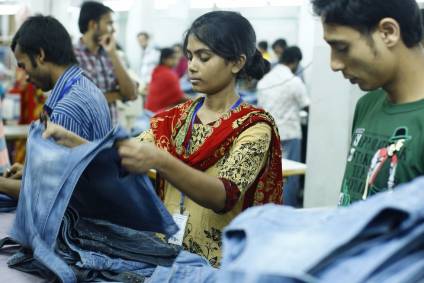
Bangladesh’s ready-made garment sector has made significant progress in the social upgradation of its workers but its economic upgrading index is low, a new report has found.
The latest findings of a research paper ‘Ongoing Upgradation in RMG Enterprises: Preliminary Results from a Survey‘ – commissioned to examine the lives of RMG workers in Bangladesh since the Rana Plaza collapse of 2013 has been published by the country’s Centre for Policy Dialogue (CPD). It shows that social improvements in the lives of the industry’s employees are evident, but that in order to make a balanced upgrade, improvement in technological readiness, management practices and workers’ skills – particularly of female workers – is “very much needed”.
Go deeper with GlobalData


Discover B2B Marketing That Performs
Combine business intelligence and editorial excellence to reach engaged professionals across 36 leading media platforms.
Prepared based on the data of an ongoing survey conducted at 193 factories with more than 2,400 workers, the report found that on a scale of 0-100, the overall score of the economic upgrading index is low, mostly within 0-20 and 0-40. Around 18% of large factories have scores over 60, which indicates higher progress. While none of the small and medium factories reached that level because of their lack of progress in terms of economic upgrading.
The study, which examined the state of transformation of the RMG sector post-Rana Plaza, revealed that the share of female workers is slowly rising in the lower grades, but that the percentage remains “very marginal” in the top grades.
It found that around 47% of large enterprises and 25% of medium enterprises use advanced technology but that smaller enterprises are still lagging in terms of technology adoption. Female workers were found to be proportionately less knowledgeable about operating different machines compared to their male peers.
Speaking at the launch of the report at the weekend, Siddiqur Rahman, president of the Bangladesh Garment Manufacturers and Exporters Association (BGMEA), said the reason the social upgradation rate was significantly higher than economic upgradation was because there was increasing pressure from the international communities to adopt new measures of social compliance post-Rana Plaza. In contrast, the demand for apparel products are declining in the international market on the back of rising production costs which has not helped the economic stature, he maintained.
Mikail Shipar, Former Secretary, Ministry of Labour and Employment, believes the number of female workers is declining due to the growth of industrial automation in the sector. While economist Dr A K Enamul Haque emphasises the need to introduce specialized educational courses to mitigate the rising number of foreign professionals in the sector.
CPD chairman, Professor Rehman Sobhan, urged major brands and international buyers to address the prevailing gap in garment production costs and retail price.
Based on the analysis of the complete survey data, the study will come up with appropriate policy recommendations towards making the RMG sector more competitive and compliant in August.



