
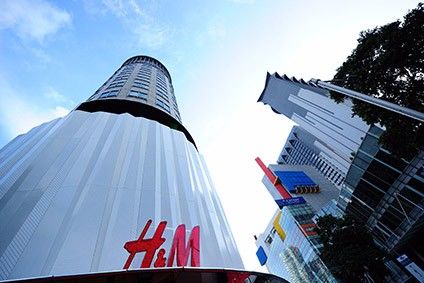
Swedish fashion retailer H&M has identified three action areas in the wake of a disappointing full-year and fourth-quarter performance, including further investment in its supply chain and the launch of a discount fashion site later this year.
In its full-year report today (31 January), the world’s second-largest fashion retailer said profit after tax amounted to SEK3.99bn (US$509.1m) in the fourth quarter, compared to earnings of SEK5.91bn in the year-ago period. H&M said the weak sales development within its namesake brand’s physical stores lead to increased markdowns and handling costs, which had a negative impact on the result in the quarter which ran from 1 September to 30 November.
Group sales in the period, meanwhile, slipped 2% in local currencies compared to the corresponding period last year. Including VAT, sales were down 4% on last year to SEK58.48bn during the quarter, while sales excluding VAT amounted to SEK50.41bn, compared to SEK52.72bn last year.
Gross margin narrowed to 55.4% in the quarter from 57% in the year-ago period.
For the full year, H&M said profit after tax amounted to SEK16.18bn, compared to earnings of SEK18.64bn in the previous financial year.
Group sales for the period meanwhile, were up 3% in local currencies, while sales including VAT increased 4% to SEK231.77bn, compared to SEK222.86bn last year. Excluding VAT, sales amounted to SEK200bn for the year from SEK192.27bn a year earlier.
Gross margin for the year narrowed slightly to 54% from 55.2% in the previous year.
Looking ahead, H&M says it expects sales in the period 1 December 2017 to 31 January 2018 to increase by 1% in local currencies compared to the corresponding period the previous year.
“Our performance during 2017 was mixed, with progress in some areas but also difficulties in others,” says CEO Karl-Johan Persson. “We delivered growth of 3% in 2017 which is clearly below our expectations. In the fourth quarter, our sales overall decreased by 2% in local currencies. Our online sales and our newer brands performed well but the weakness was in H&M’s physical stores where the changes in customer behaviour are being felt most strongly and footfall has reduced with more sales online. In addition, some imbalances in certain aspects of the H&M brand’s assortment and composition also contributed to this weaker result.”
He adds the group’s performance, however, needs to be seen in the “wider context of the transformation that the industry is going through”, noting there are reasons for optimism but the retailer needs to accelerate its transformation.
As a result, H&M has developed three main action areas:
Be restless around the core
- H&M must always have the best across product assortment and mix, look, value for money and sustainability.
- Its physical stores must offer a more inspiring and convenient customer experience, and be more customised to local needs.
- The digital store offering needs to be constantly improved and broadened to ensure it maximises engagement and sales.
- Integrating the physical and digital stores to offer customers a great shopping experience.
Invest in the enablers – new technology and ways of working
- H&M says the efficiency of its supply chain has always been a strength but it must mirror its customers’ fast-changing needs, with plans to invest further in a bid to get even faster, more flexible and more responsive.
- More investment in analytics and intelligence, with H&M saying it sees “huge potential” across the board from assortment planning to supply chain and sales.
- Continued investment in tech foundation, including broadening its use of technologies like Cloud, RFID and 3D.
Drive growth – both traditional and new
- The H&M group is developing new brands for new needs and new segments – it now has eight brands it says are “scalable” – and will soon launch its ninth brand, Afound.
- Accelerated digital expansion.
- Continue to open new stores.
- Optimise and refine its physical store portfolio.
- Constantly work on new ideas and innovations that will drive the group forward.
Meanwhile, a continued roll-out of H&M’s online store is planned to another four markets during the financial year 2017/2018: India, and via franchise to Saudi Arabia and the United Arab Emirates. Kuwait was opened in December 2017 via franchise. The group also plans to open around 390 new stores in the period and shutter 170, resulting in a net addition of approximately 220 stores. New planned H&M store markets are Uruguay and Ukraine.
The retailer has also announced plans to launch a new brand – Afound – in 2018. Afound will be an off-price marketplace offering products from well-known and popular fashion and lifestyle brands, both external brands and those from the H&M group, says the company. It will be launched in Sweden, with a first store in Stockholm opening in parallel with a digital marketplace in Sweden.
Earlier this month, reports suggested H&M has already inked agreements with 60 brands as part of the launch and a so-called secret bid to become a “digital powerhouse”.
H&M preparing to launch discount fashion site?
Looking ahead, Persson acknowledges how fast the fashion industry is changing – at the heart of which is digitalization – which he says is “driving the need to transform and re-think faster and faster”.
“This is presenting many challenges but we believe we are well-placed to adjust to the new dynamics and take advantage of the opportunities in front of us.”
He adds: “All in all, we feel 2017 was a year where we made more steps forward and did more groundwork for the future, but we have also made some mistakes that have slowed us down.
“The new fashion landscape requires skills and resources to adapt and seize the new opportunities. In particular the ability to take a long-term view and to navigate through some inevitable turbulence. By long-term investments, we have built a solid platform for many years of continued growth.”
Pedro Aguilar, senior beauty and fashion analyst at Euromonitor International notes that while H&M was once a pioneer in the fast fashion movement, it now looks like the company has failed to keep up.
“In recent years, younger more agile near pure online fast fashion companies like Asos and Boohoo have slashed average lead times, almost pushing out new items at a continuous pace,” he adds. “H&M still remains heavily reliant on Asia for the majority of its production and consequently has significantly longer average lead times and even lags well behind rival Inditex which mostly produces at home in Spain and neighbouring countries to stay highly responsive to consumer demand. And this, time from design-to-shelf, is crucial in today’s fashion world.
“Ultimately a direct consequence of fast fashion, consumers have become accustomed to a constant flow of new designs with trends emerging and fading more rapidly than ever before. A slow supply chain also means being unresponsive to consumer demand, which is perhaps why H&M has tried to diversify sales away from its eponymous brand to decrease its current reliance on fast fashion.”
Meanwhile, Aguilar says the areas H&M has recognised where it needs to improve are major challenges, particularly for a company the size of H&M. “Remaining agile and responsive to the fast changing nature of the fashion industry for an organisation the scale of H&M requires a highly reactive approach to its internal operations.”



