
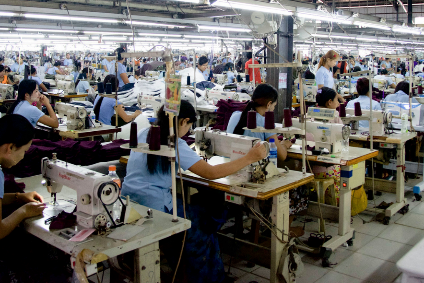
Workers in Cambodia and Myanmar are among the hardest hit by fall-out from the global coronavirus (Covid-19) outbreak, according to unions who are urging measures to protect workers.
Garment factories rely on raw materials from China, and as manufacturing plunged in China, factory owners in Cambodia and Myanmar have begun suspending operations and retrenching workers.
Ten factories in Cambodia informed the government that production would be suspended. It is estimated that 200 factories in the sector will either suspend operations or slow production. One source reported that 5,000 Cambodian workers have already lost their jobs.
Factories who have suspended operations are obliged to pay workers 60% of the minimum wage, and the Cambodian government has offered affected employers to pay 20% of that.
During the suspension, workers are to receive training conducted by the Ministry of Labour and Vocational Training at the workplace.
The economic situation in Myanmar is also acute. The Confederation of Trade Unions of Myanmar has sounded alarm bells over the lack of raw materials from China that has caused the closure of 16 factories 7,000 layoffs.
Union representatives are meeting with employers and the government this week to discuss the issue. IndustriAll affiliate, the Industrial Workers Federation of Myanmar (IWFM), will also approach brands sourcing from Myanmar to discuss the impact on workers.
“There are policy measures that can be taken,” says IWFM president Khaing Zar. “The government can create a special fund to support affected workers, consider tax reductions on electricity and provide soft loans to employers.”
Annie Adviento, IndustriAll South East Asia regional secretary, has welcomed the Cambodian government’s announcement, but urges the government to be prudent in approving the application of lowering the minimum wage.
“It’s an emergency measure that could easily be exploited by employers by not paying minimum wage to workers. There must be a due diligence process to prevent frauds.
“As many jobs as possible must be saved and the government should intervene when workers lose salaries. Both Cambodia and Myanmar have participated in ILO’s decent work country programme, which focuses on employment creation and social protection for workers.”
Brands and retailers have also been urged by the Fair Labor Association (FLA) to heed the financial strain of the coronavirus and the impact of delayed production on suppliers, and try to mitigate potential risks such as overtime, and non-payment of wages.
“Buyers should strongly consider providing flexibility on delivery dates, payment terms, financial liability, and continue to uphold responsible purchasing practices to mitigate negative impacts on suppliers and workers,” it says.
This article was first published by the IndustriAll global union.


