
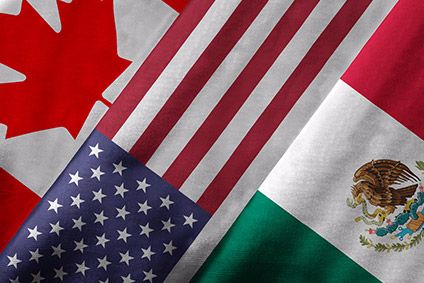
While “some” progress has been made in the sixth round of renegotiations to modernise the North American Free Trade Agreement (NAFTA) that concluded this week, the US has once again expressed concerns over the slow progress of the talks and addressed the so-called “misunderstanding” that it is being unfair in the negotiations.
Following the meetings in Montreal, Canada, that concluded this week, United States Trade Representative Robert Lighthizer observed that while the US, Canada and Mexico “finally” began to discuss some of the core issues, marking this round of discussions as a step forward, the group is “progressing very slowly”.
He warned: “We owe it to our citizens, who are operating in a state of uncertainty, to move much faster”, but acknowledged negotiating as a group of three is more difficult than bilateral talks.
Meanwhile, Lighthizer also used his closing statement to discuss the US’s bilateral trade relationship with Canada, adding: “I think there is some misunderstanding here that the United States is somehow being unfair in these negotiations and that is not the case.”
Earlier this month, Canada filed a complaint with the World Trade Organization against the US, highlighting a slew of measures relating to anti-dumping and anti-subsidy duties it says are inconsistent with America’s WTO obligations.
The challenge by Canada, filed on 20 December and set out in a 32-page document, offered 200 examples of alleged US wrongdoing related to its trade with Canada, as well as America’s other trading partners such as China, the European Union (EU), Brazil and India.
Canada takes US to task over “unfair” trade practices
Using Canadian statistics, Lighthizer said Canada sold America US$298bn in goods in 2016, while the US sold Canada $210bn.
“Now that’s a lot of two-way trade, but it also means that Canada has an over $87bn US dollar surplus with the United States,” he explained. “To put this in perspective, that figure is equal to approximately 5.7% of Canada’s GDP. When energy is removed, and in some people’s opinion that’s a fair thing to do, the number is still $46bn dollars. The projected figures for 2017 show that the surplus will be even larger when those numbers are in.
“Now I ask Canadians because we’re in Canada, is it not fair for us to wonder whether this imbalance could in part be caused by the rules of NAFTA? Would Canada not ask this same question if the situation were reversed? So we need to modernise and we need to rebalance.”
Lighthizer also addressed what he referred to as “two proposals by the Canadians”, including the “presumed compromise on rules of origin”.
Last week, a cohort of apparel industry associations joined forces to urge NAFTA trade ministers to negotiate rules of origin that preserve existing flexibilities, avoid new restrictions, and include new provisions that expand trade.
Apparel groups urge NAFTA negotiation on rules of origin
But according to the US Trade Representative, when analysed, the US found the automobile rules of origin idea “may actually lead to less regional content than we have now and fewer jobs in the United States, Canada, and likely Mexico”, adding “this is the opposite of what we are trying to do.”
He added in another proposal, Canada reserved the right to treat the United States and Mexico “even worse” than other countries if they enter into future agreements. “Those other countries may, in fact, even include China, if there is an agreement between China and [Canada],” he said. “This proposal, I think if the United States had made it, would be dubbed a “poison pill.” We did not make it, though. Obviously, this is unacceptable to us, and my guess is it is to the Mexican side also.”
Lighthizer also drew attention to what he dubbed “unprecedented trade action” that Canada brought against the US. “It constitutes a massive attack on all of our trade laws,” he added.
“If it were successful, it would lead to more Chinese imports into the United States and likely fewer Canadian goods being sold in our market. Now we understand that countries often challenge specific actions taken by another country in the context of trade laws. This is normal and what we expect. But this litigation essentially claims that 24 years ago, the United States effectively gave away its entire trade regime in the Uruguay Round. Of course, we view this case as frivolous, but it does make one wonder if all parties are truly committed to mutually beneficial trade.
“It also underscores why so many of us are concerned about binding dispute arbitration. What sovereign nation would trust to arbitrators or the flip of a coin their entire defence against unfair trade?”
In concluding, Lighthizer said “some real headway” was made during the talks and that the US views NAFTA as a “very important agreement”.
He added: “We are committed to moving forward. I am hopeful progress will accelerate soon. We will work very hard between now and the beginning of the next round, and we hope for major breakthroughs during that period. We will engage with both Mexico and Canada urgently, and we will go where these negotiations take us.”


