

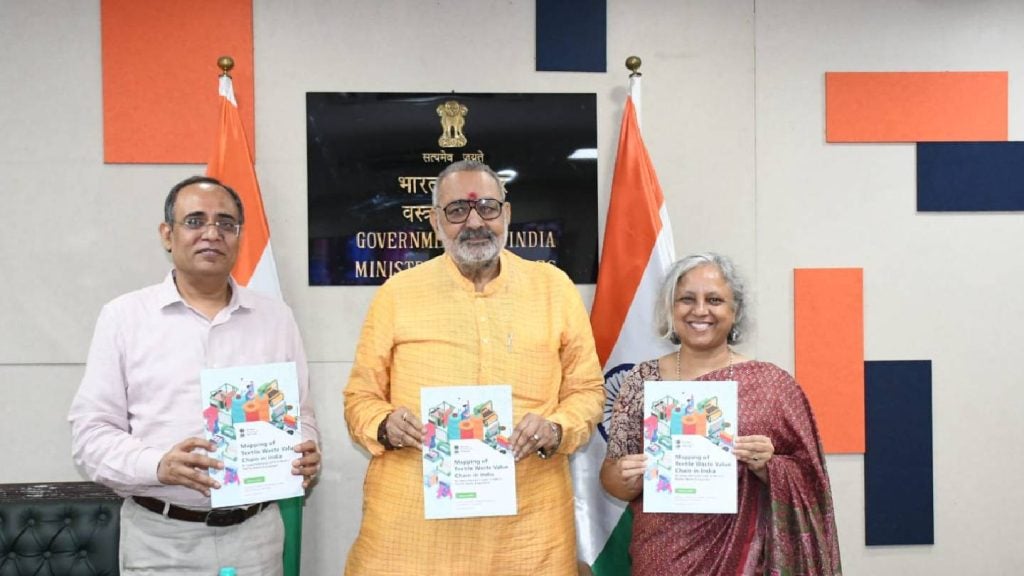
Union Minister of Textiles Giriraj Singh released the report, Mapping of Textile Waste Value Chain in India, at an event in New Delhi on 10 March 2026.
The document examines the scale of textile waste generation, outlines recovery methods and recycling technologies, and highlights options to improve circularity within India’s textile sector.
The report claims India’s recycling market in India could create 100,000 new green jobs. While mechanical recycling remains the primary method for processing textile waste, chemical recycling is emerging as an alternative approach for recovering fibres at the molecular level and could enable textile-to-textile recycling.
The document also shares that the nation currently generates around 7.07 million tonnes of textile waste annually, with 42% coming from pre-consumer sources and 58% from post-consumer disposal.
Of the total waste generated, more than 70% is presently recovered through recycling, upcycling, downcycling and reuse initiatives.
Analysis in the report claims that around 95% of pre-consumer textile waste is recovered, which is says shows the strength of recovery networks within the value chain.
The spinning sector sets a notable example, with the report stating that “nearly 100% of spinning waste” is reused in production. Immediate reuse is possible due to consistent material quality and established standards within the sector.
For post-consumer waste, the study claims that around 55% is diverted from landfill, largely due to informal collection and sorting networks.
This system supports between 4 and 4.5 million livelihoods, most of which are held by women from marginalised backgrounds engaged in the handling and redistribution of used textiles.
The report identifies Panipat in the state of Haryana as a significant centre for mechanical textile recycling in India. It indicates that establishing recycling infrastructure at the cluster level in major textile hubs could “significantly improve” efficiency and enable waste to be processed closer to its source.
At a launch event for the report, Union Minister Giriraj Singh stated that India’s textile sector is “one of the largest in the world,” and noted its “significant potential” to lead the global shift towards sustainable and circular production systems.
He added that the report provides a "data-driven blueprint" for transforming textile waste into a valuable economic resource.