
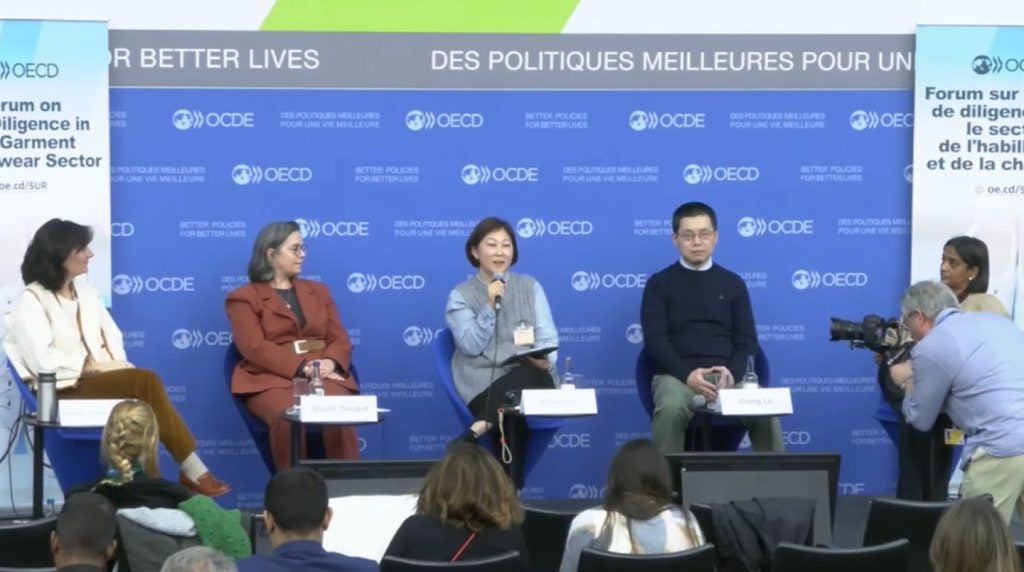
The event brought together representatives from governments, industry, trade unions, civil society, and international organisations to discuss emerging challenges and practices related to supply chain due diligence.
During the event, ShinWon Corporate Strategy Group vice president Eunice Kim, contributed to a panel titled “Supply Chains 4.0: Due Diligence Implications of E-Commerce-Driven Business Models.”
ShinWon operates 15 entities in ten countries including Indonesia, Vietnam, Bangladesh, Guatemala, and Nicaragua, and employs around 30,000 people globally. The majority of its workforce is women.
The discussion focused on how the rise of e-commerce and demand-led business models are changing production systems, sourcing methods, supplier relationships and responsible business practices within the industry.
Kim described ShinWon's use of digital tools to monitor factory operations, stating, “At ShinWon, digital tools have fundamentally changed how we manage production at the factory level. Through real-time production dashboards and integrated ERP systems, we monitor line efficiency, capacity utilization and absenteeism on a daily basis. This enables dynamic scheduling adjustments based on data, rather than last-minute reactive decisions, and increases overall predictability.”
She noted that transparent data sharing with brand partners has altered how production adjustments are handled, allowing for earlier communication about capacity constraints, lead times and compliance needs.
Kim said: “Flexibility combined with shared data and accountability can reduce risk. It supports better workforce planning, more stable working hours and more predictable operations. Responsiveness, when managed through transparency and partnership, strengthens responsible business conduct rather than undermining it.”
She outlined ShinWon's risk management system, which uses digital dashboards to monitor working hours every day and triggers alerts if overtime nears regulatory or internal thresholds.
Kim emphasised, “Speed itself is not the risk. Lack of transparency is,” highlighting the importance of moving towards long-term partnerships with global brands to support responsible supply chain practices.
The session also examined operational complexity faced by manufacturers working under various compliance standards set by different brands.
Kim argued that harmonisation of standards would simplify processes and improve due diligence outcomes across the sector. She noted that aligning organisational practices with risk awareness is required, in addition to technical systems, to scale responsible production models.