


Artificial intelligence has rapidly evolved from an emerging technology into a transformative force reshaping industries around the world. Yet for fashion companies, the conversation is no longer about AI itself. The real question is how to translate technological advances into better decisions, more efficient operations and stronger business performance.
At a time when brands face increasing pressure to improve profitability, accelerate product development, strengthen supply chain resilience and meet growing sustainability expectations, many are discovering that AI’s true value lies not in standalone applications but in its ability to connect people, data and processes across the entire value chain.
This is a perspective that Lectra has been helping customers navigate for decades.
Through software, data, cutting equipment and services, Lectra supports fashion brands, retailers and manufacturers at every stage of their operations. Today, the company is combining this deep industry expertise with advanced technologies, including agentic AI, to help its customers rethink how fashion products are created, manufactured, marketed and traced.
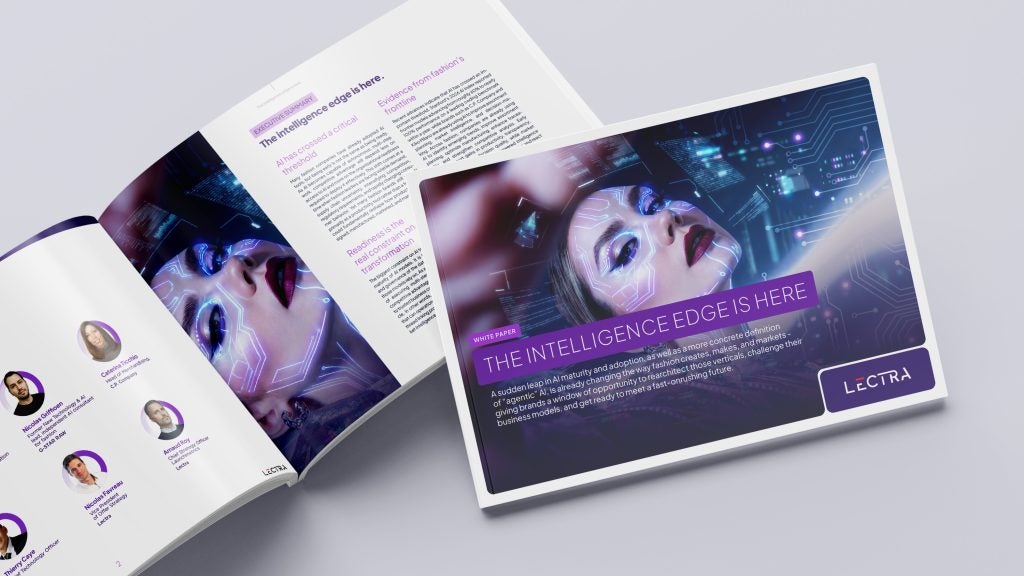
As explored in the Lectra Observatory’s latest white paper, The Intelligence Edge Is Here, organizations that successfully combine AI with trusted data, deep industry expertise and connected workflows will be best positioned to build lasting competitive advantage in an increasingly complex market.
Readiness is the real constraint on AI transformation
The biggest constraint on AI transformation is not the maturity of AI models. It is the quality, connectivity, and governance of the data and business processes those models rely on. As agentic AI becomes capable of executing multi-step workflows autonomously, competitive advantage will come from connecting AI to trusted business context across the product lifecycle. In other words, the winners will be organizations that can operationalize AI through a continuous digital thread linking product, sourcing, manufacturing, market intelligence, and customer data.
AI will transform every stage of the fashion value chain
From product creation and development to manufacturing, market intelligence, marketing, traceability, and collaboration, AI is reshaping how fashion companies make decisions, execute workflows, and create value across the entire product lifecycle.
Drawing on insights from fashion executives, AI specialists, and industry leaders, the report highlights five key areas where AI is delivering tangible benefits.

1/ Create with intelligence
Fashion starts with product creation. As collections become more complex, brands need to move faster without compromising creativity.
With access to product data, past collections and market insights, AI helps teams streamline development and make better-informed decisions. For instance, Apogy, Lectra’s new product development solution, connects teams, centralizes information and accelerates collaboration. By turning product data into a shared source of intelligence, brands can reduce product development time by up to 30%, improve efficiency and bring better products to market faster.
“For the first time in our history, all our teams are using a single solution. This harmonization eliminates errors linked to data transfers, increases transparency and now enables us to accelerate operations, improve productivity and effectively support our growth.”
David Towell, Senior Manager, O’Neills
2/ Manufacture with intelligence
In manufacturing, competitiveness depends on efficiency, agility and visibility.
AI helps companies improve planning, optimize resources and make faster operational decisions. By connecting production data across suppliers and facilities, businesses gain a clearer view of performance, costs and risks, enabling more resilient operations. Solutions such as Valia Fashion help provide this visibility across the production ecosystem. For companies pursuing growth, the impact goes beyond operational efficiency to supporting greater scale and responsiveness.
“Looking ahead, with Valia Fashion, we’re confident that we can double our business over the next three to five years, and Lectra will play a key role in helping us get there.”
Keith Christiansen, President & GM, Chicago Protective Apparel
3/ Market with intelligence
Understanding the market has never been more complex. Consumer preferences evolve rapidly. Competitive landscapes shift constantly. Brands need to monitor thousands of products, channels, campaigns and signals to understand what is driving performance. By processing vast quantities of information, AI can help democratize access to insights, reveal emerging market dynamics and support better commercial decisions.
AI helps transform large volumes of market and performance data into actionable insights. With solutions such as Retviews and Launchmetrics, brands can better understand competitor positioning, emerging opportunities and marketing impact, helping teams make more confident decisions.
“Retviews has become a key tool for our teams. The solution provides us with early signals to make more confident adjustments and better interpret market dynamics, fundamentally transforming our approach to collection development.”
Caterina Ticchio, Head of Merchandising & Planning, CP Company
4/ Trace with intelligence
As transparency requirements continue to rise, access to trusted supply chain data is becoming essential.
Preparing for Digital Product Passports (DPPs) starts with building the right data foundation. AI helps organizations manage complex information, improve data reliability and support more informed sourcing and compliance decisions. Through solutions such as TextileGenesis, brands can strengthen traceability across the supply chain while preparing for evolving regulatory requirements and sustainability goals.
This keeps the focus on the business challenge first (DPP readiness), introduces the importance of a data foundation, and only then mentions the solution, which feels more aligned with Lectra’s thought-leadership style.
5/ Collaborate with intelligence
The fashion industry generates vast amounts of product data, yet too often it remains fragmented across teams, systems and partners.
As AI becomes more embedded across the value chain, its effectiveness depends on access to consistent, connected and trusted data. This requires more than a traditional PLM. Brands need a modern product data foundation that connects design, development, sourcing, manufacturing and compliance within a single collaborative environment.
By bringing together people, processes and product information, next-generation solutions such as Kubix Link enable teams to work from a single source of truth, improve cross-functional collaboration and accelerate decision-making. They also create the foundation needed to support new requirements such as Digital Product Passports (DPPs) and AI-powered workflows.
Sparking transformation across the fashion value chain
AI is becoming a catalyst for change across fashion, from creation and manufacturing to market intelligence, collaboration and traceability.
The organizations that succeed will be those that combine human expertise with trusted data and connected workflows, enabling faster decisions, greater agility and a lasting competitive advantage.
For those companies, AI will become far more than a productivity tool. It will become a competitive advantage.
And with decades of experience at the intersection of fashion, technology and innovation, Lectra is helping make that transformation possible.
Download the Lectra Observatory white paper, The Intelligence Edge Is Here, to explore how AI, data and connected workflows are reshaping how fashion creates, manufactures, markets, traces and collaborates.
