
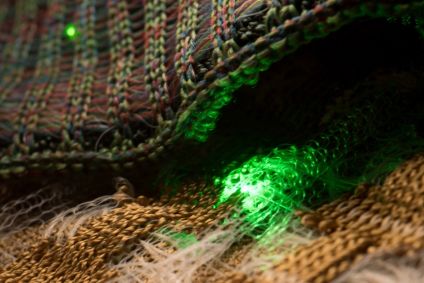
Researchers in the US are claiming a world-first by producing fibres with embedded electronics that are so flexible they can be woven into soft fabrics and made into wearable clothing.
The development by a team at the Massachusetts Institute of Technology (MIT) is said to have solved one of the long-standing challenges of creating “smart” fabrics by incorporating semiconductor devices – the key ingredient of modern electronics – into textiles and fibres.
Go deeper with GlobalData


Discover B2B Marketing That Performs
Combine business intelligence and editorial excellence to reach engaged professionals across 36 leading media platforms.
The fibres were embedded with high speed optoelectronic semiconductor devices, including light-emitting diodes (LEDs) and diode photodetectors, and then woven at Inman Mills, in South Carolina, into soft, washable fabrics and made into communication systems – in effect making fabrics with sophisticated functionality.
This discovery, the researchers say, could unleash a new ‘Moore’s Law’ for fibres – in other words, a rapid progression in which the capabilities of fibres would grow rapidly and exponentially over time, just as the capabilities of microchips have grown over decades.
The findings are described in the journal Nature in a paper by former MIT graduate student Michael Rein; his research advisor Yoel Fink, MIT professor of materials science and electrical engineering and CEO of AFFOA (Advanced Functional Fabrics of America); along with a team from MIT, AFFOA, Inman Mills, EPFL in Lausanne, Switzerland, and Lincoln Laboratory.
Optical fibres have been traditionally produced by making a cylindrical object called a “preform,” which is essentially a scaled-up model of the fibre, then heating it. Softened material is then drawn or pulled downward under tension and the resulting fibre is collected on a spool.
The key breakthrough for producing these new fibres was to add to the preform light-emitting semiconductor diodes the size of a grain of sand, and a pair of copper wires a fraction of a hair’s width. When heated in a furnace during the fibre-drawing process, the polymer preform partially liquified, forming a long fibre with the diodes lined up along its centre and connected by the copper wires.
One of the advantages of incorporating function into the fibre material itself is that the resulting fibre is inherently waterproof.
Though the principle sounds simple, making it work consistently, and making sure that the fibres could be manufactured reliably and in quantity, has been a long and difficult process. The first commercial products incorporating this technology are expected to reach the marketplace as early as next year.
Beyond communications, the fibres could potentially have significant applications in the biomedical field: for example, a wristband that could measure pulse or blood oxygen levels, or a bandage to continuously monitor the healing process.
An interview on just-style last week, Matt Kolmes, CEO at Supreme Corporation, discussed how the company’s Volt Smart Yarns division has been gaining momentum in the smart fabrics industry: Volt Smart Yarns bridging the gap on wearables.



